Most writing about AI in business is either a vendor case study or a prediction. Both are easy to produce and neither tells you much. What is genuinely useful is the smaller set of cases where a company stated publicly what they deployed and what changed — ideally with a number attached, and ideally including the parts that did not go well.
Here are four, with what each one does and does not tell you.
1. Klarna's customer service assistant
In February 2024, the payments company Klarna announced that an AI assistant built with OpenAI was handling two-thirds of its customer service chats in its first month — around 2.3 million conversations — and that it was doing the work equivalent of roughly 700 full-time agents. They reported resolution times dropping from 11 minutes to under 2, with customer satisfaction scores comparable to human agents.
The part worth knowing is what came after. By 2025, Klarna's CEO publicly acknowledged they had cut too far, that quality had suffered, and the company began rehiring human agents for cases where customers wanted a person.
That correction is the most valuable detail in the whole story. The technology worked. The mistake was treating it as a total replacement rather than a first line that knows when to hand over.
What it tells a smaller business
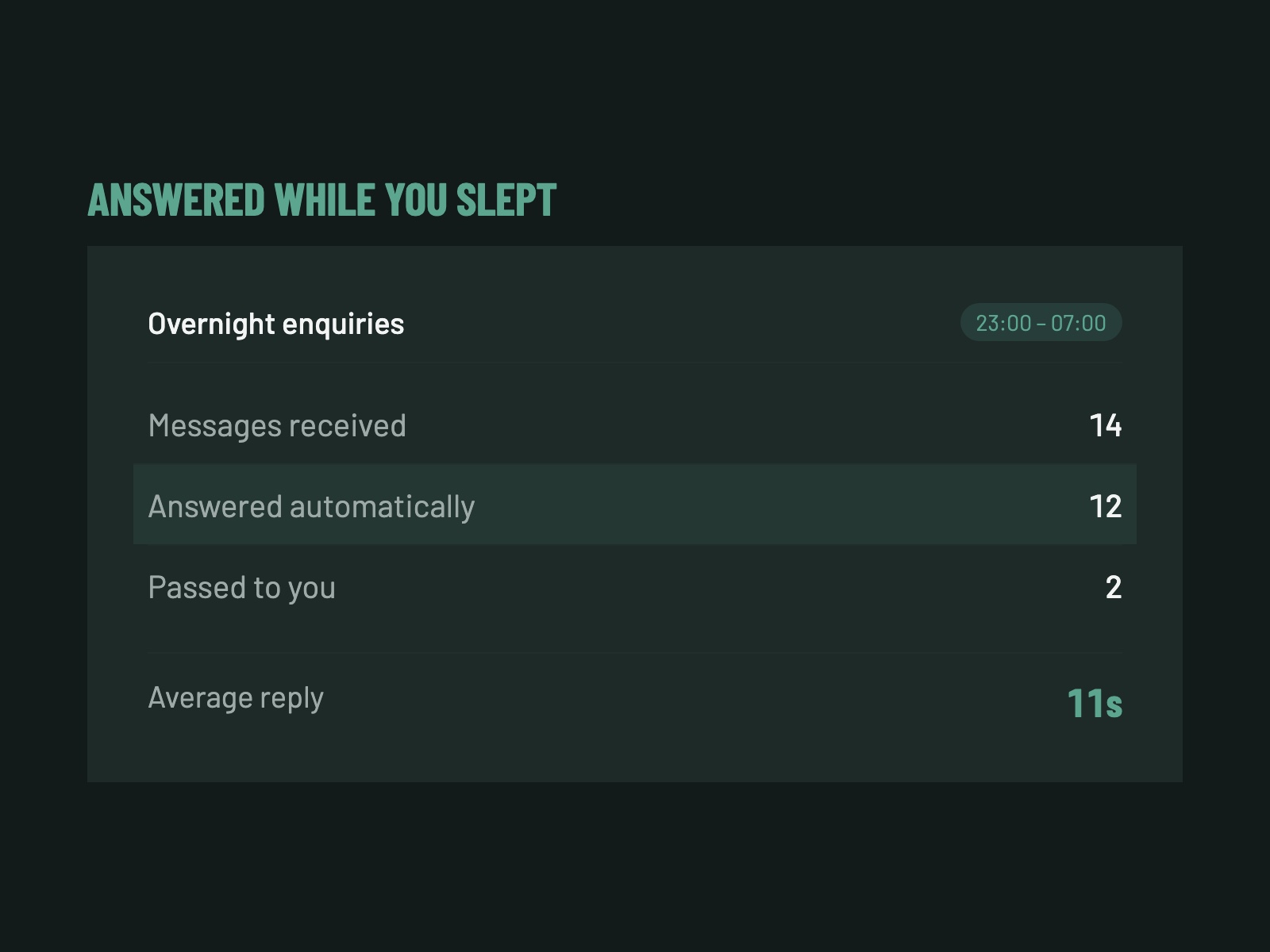
Repetitive, high-volume enquiries — "where is my order", "what are your hours", "how do I change my booking" — are genuinely well suited to this. The lesson from the reversal is that the handover to a human needs to be easy and obvious, not buried.
2. GitHub Copilot and developer speed
GitHub ran a controlled experiment with 95 developers, splitting them into two groups to write an HTTP server. The group with Copilot finished 55% faster on average — 71 minutes versus 161. The results were published in a peer-reviewed style writeup rather than a marketing page.
The caveat matters: this was one well-defined task with a clear finish line, not the messy work of maintaining an existing system. Later independent research has found more modest gains in real-world conditions, and some studies have found experienced developers working on familiar codebases can be slower with AI assistance while believing they were faster.
What it tells a smaller business
Gains are real but concentrated in well-scoped, repetitive work. Treat "55% faster" as the ceiling for ideal conditions, not a number to budget against.
3. Document processing in insurance and finance
This is less glamorous than chatbots and, for most small businesses, considerably more useful. Extracting structured information from invoices, receipts, and forms was historically done with rigid template-matching that broke whenever a supplier changed their layout. Modern models handle variation far better.
Published deployments in this area consistently report the same shape of result: substantial reductions in manual handling time for documents that previously required a person to read and retype. The reason it works is that the task is narrow, the output is checkable, and a mistake is visible immediately rather than silently wrong.
What it tells a smaller business
If anyone in your business retypes information from a PDF or a photo into a system, this is almost certainly the highest-return AI project available to you. It is unglamorous, it is well understood, and it usually pays back quickly.
4. Meeting transcription and note-taking
The least discussed and most widely adopted. Automatic transcription with summarisation is now standard in Zoom, Teams, and Google Meet, and reliable enough that entire professions have quietly stopped taking notes by hand.
There is no dramatic case study here, which is rather the point. It works, it required no integration project, and the failure mode is a slightly wrong summary that a human notices and corrects.
What these cases have in common
Reading them together, a pattern emerges. The successful deployments share four traits:
- The task is narrow and repetitive — one kind of thing, many times.
- The output is checkable. A human can tell at a glance whether it is right.
- Mistakes are recoverable. Nothing irreversible happens without review.
- There is a path to a human. Klarna's correction is the clearest evidence for this one.
The failures share the opposite: broad, judgement-heavy tasks where errors are hard to spot and expensive to unwind.
The useful question is not "where could we use AI?" but "where do we do the same checkable thing over and over?"
What this means for a small business
You are not going to deploy something at Klarna's scale, and you do not need to. The realistic wins look like this: a first-line assistant for your most common customer questions, with a clear route to reaching you. Document extraction so nobody retypes invoice data. Transcription so meetings produce notes without effort. Drafting assistance where a human still approves what goes out.
What these have in common is that they sit alongside a person rather than replacing one. In a small business that is not a compromise — it is the entire point. Your customers deal with you directly, and that is usually why they chose you.


Three businesses we work with.
← All writing