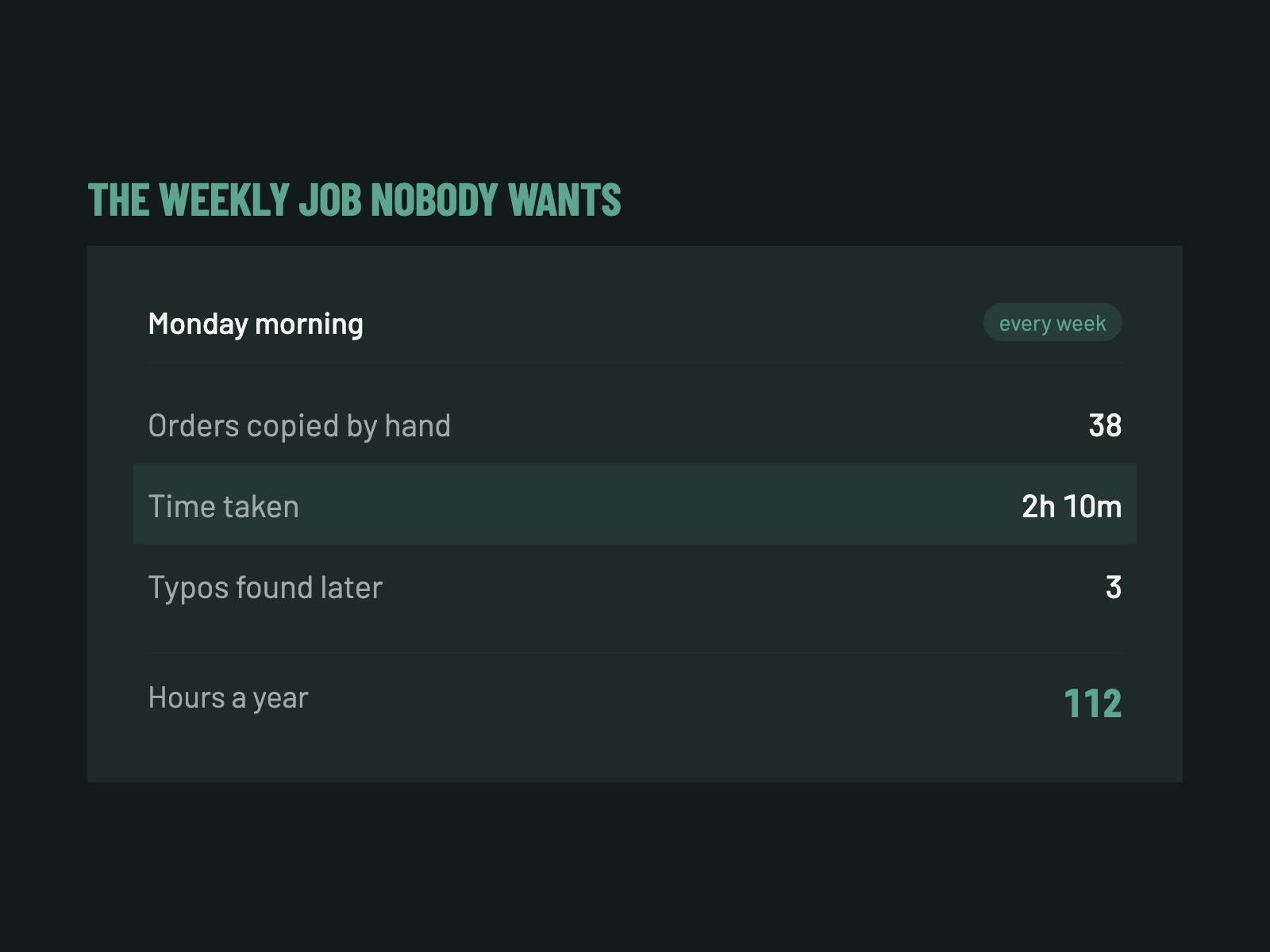
When a company with two thousand employees automates a process, the benefit shows up on a spreadsheet. Some number of hours per month get freed up, spread thinly across a large team, and someone in finance records the saving.
When a business with six people automates the same process, something different happens. The person who was doing that task gets their Thursday afternoon back. That is not a line item. That is the difference between keeping up and falling behind.
This is the part that gets missed in most conversations about automation. The technology is the same either way. The impact is not, because in a small business there is no bench. Nobody is standing by to absorb the overflow. Every hour spent copying data between two systems is an hour not spent on the work that actually brings money in.
The tasks worth automating first
Not everything should be automated, and the instinct to automate the most annoying task is usually wrong. The most annoying task is often the most irregular one, which makes it the hardest and most expensive to automate reliably.
A task is a good candidate when it has most of these properties:
- It repeats on a predictable trigger — every new order, every Monday, every form submission.
- The rules are the same every time. If a human has to make a judgement call, that is a decision point, not a step.
- The data already lives somewhere digital. Automating a process that starts with a handwritten note means solving handwriting first.
- Getting it wrong is recoverable. Start where a mistake means a re-send, not a lost customer.
Run your recurring work through that filter and the list usually gets short quickly. That is a good thing. A short list of well-chosen automations that run for years is worth far more than a dozen fragile ones nobody trusts.
A worked example
Consider a small property business taking bookings by email and WhatsApp. The owner copies each booking into a spreadsheet, sends a confirmation, adds the dates to a calendar, and sets a reminder to follow up for the balance payment a week before arrival.
That is four steps, perhaps six minutes each time, and it happens maybe forty times a month. Call it four hours. Not catastrophic — which is exactly why it survives for years without anyone questioning it.
The hidden cost is not the four hours. It is that the follow-up reminder gets forgotten during a busy week, and a guest arrives without having paid the balance. It is that the spreadsheet and the calendar disagree because one got updated and the other did not. The real return on automating this is not the time. It is the errors that stop happening.
The question is rarely "how many hours will this save?" It is usually "what goes wrong when this gets skipped, and how often is it skipped?"
What automation is not
It is not replacing your team. In a business of six people there is no headcount to remove, and anyone selling you automation on that basis has misunderstood the problem.
It is also not a one-off project that finishes. Automations sit on top of other people's systems, and those systems change. A payment provider updates their format, a form field gets renamed, and something quietly stops working. Any automation worth building needs to tell you when it fails. An automation that fails silently is worse than no automation, because you have stopped checking.
Where to start
Pick one task. Preferably a boring, frequent, low-risk one. Write down every step by hand, including the parts that feel too obvious to write down — those are usually where the exceptions hide.
Then automate that one thing and live with it for a month. You will learn more from one automation running in your actual business than from any amount of planning about the other fifteen.



Three businesses we work with.
← All writing